
 Visit Us Today


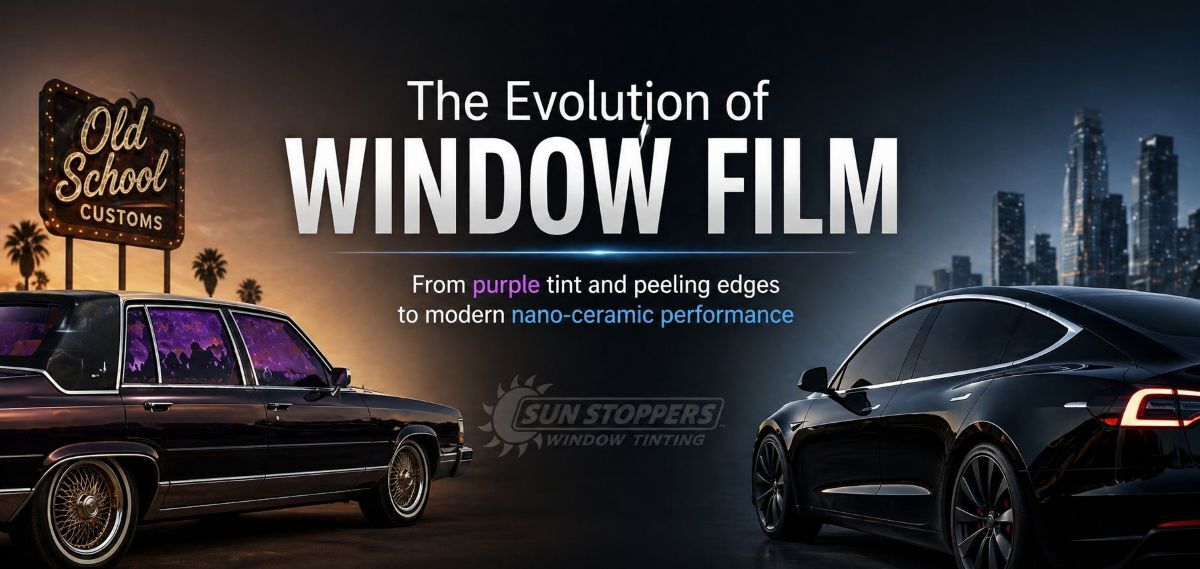
From purple-tinted failures and peeling edges to nano-ceramic technology that outperforms the glass it’s applied to — the evolution of window film is a story most customers have never heard.
Most people think window tint is window tint. They remember seeing that faded, purple-ish film peeling off a car window in a mall parking lot circa 1994, and somewhere in the back of their mind, that’s still the reference point. It isn’t. Not even close.
What’s being installed on vehicles, homes, and commercial buildings today is a fundamentally different product — engineered at a molecular level, built for performance, and backed by serious manufacturing science. Understanding where the industry started and how far it’s come matters, especially if you’re trying to make a smart decision about what goes on your car or your property.
The window film industry didn’t just improve incrementally. It went through the kind of transformation that makes the original product almost unrecognizable.
Where It All Started
The foundation of window film is polyester — and the earliest versions were about as basic as that sounds. Thin polyester substrates, organic dyes for color and shading, and adhesives that weren’t built to survive years of UV bombardment and thermal cycling. The technology existed to block some light. That was mostly it.
What changed the trajectory of materials science broadly — including window film — was the space race. The engineering demands of aerospace pushed innovation in heat resistance, light management, and material durability in ways that eventually worked their way into commercial applications. Early pioneers like Courtaulds laid foundational groundwork, and over time, companies like LLumar, SunTek, Eastman Chemical Company, 3M, and XPEL pushed the category into something genuinely high-performance. Each generation of product improved on the last, sometimes dramatically.
The Problems with Early Window Tint
If you bought window tint in the 1980s or early 1990s, you were essentially buying a dyed polyester sheet held to your glass with a basic adhesive. There were no scratch-resistant coatings, no meaningful UV blockers, and no engineered heat rejection. Film came off the shelf at AutoZone or Pep Boys, and almost anyone with a razor blade and a spray bottle was hanging a shingle as an installer.
The results reflected that reality.
Why did it turn purple? Cheap organic dyes couldn’t handle prolonged UV exposure. The sun would systematically break down the dye structure, shifting the film’s color toward that unmistakable violet hue. The discoloration wasn’t just cosmetic, either — it was a visual signal that the film’s functional properties were failing right along with it.
Why did it bubble and peel? Early adhesive technology and film construction simply weren’t equipped to handle the long-term combination of heat, UV radiation, and moisture cycling. The layers would delaminate — separating from each other and from the glass — creating bubbles, haze, and spreading failure across the surface. What looked bad also performed badly.
Installation itself was a different craft back then. Film didn’t mold or shrink with any precision, rear windows often required two or three separate pieces, and every cut was done by hand. A skilled installer who could make it look clean was genuinely considered an artist. That wasn’t flattery. It was a real technical achievement given what the materials allowed.
What Modern Window Film Actually Is
Fast forward to today, and the category has gone through the kind of transformation that makes the early product look like a prototype. The analogy that gets used in the industry — and it holds up — is the evolution from an iPod to an iPhone. Same general category, entirely different technology, capability, and purpose.
Modern premium window films are multi-layer engineered materials. Nano-ceramic technology allows manufacturers to achieve high infrared heat rejection without the signal interference problems of older metallic films. UV protection regularly exceeds 99%. Adhesives are designed for long-term bonding under extreme conditions. Scratch-resistant coatings protect the outer surface. Color stability is built into the construction itself, not dependent on organic dyes that break down in sunlight.
These films don’t turn purple. They don’t bubble. They don’t fail the way the old ones did — because they’re not built the same way. The performance benefits are real: measurable heat rejection, meaningful UV protection, and documented energy efficiency improvements in both automotive and architectural applications.
Today’s nano-ceramic films deliver UV protection exceeding 99% and significant infrared heat rejection — genuine performance metrics backed by materials engineering, not marketing language.
The Vehicles Themselves Changed Everything
It’s worth noting that the demands on window film have increased alongside the improvements in the product. Modern vehicles are not the same canvas they were thirty years ago. Full panoramic glass roofs, massive curved windshields, larger rear windows, and increasingly complex body lines mean that installation requires a level of precision and skill that simply didn’t exist as a requirement when cars had smaller, flatter glass panels.
Shrinking and molding film onto today’s surfaces takes real expertise. One mistake on a complex curve can compromise the entire installation and potentially cost thousands of dollars. The technical bar has risen substantially — both because the materials are more sophisticated and because the surfaces they’re applied to demand more from the installer.
The Business Behind the Installation Has Evolved, Too
Here’s where most customers don’t see the full picture. Running a professional window film operation today looks nothing like the small-shop, grab-a-roll-off-the-shelf model of thirty years ago. A legitimate installation business in the current market operates with retail storefronts, climate-controlled environments, computer-cutting systems with software subscriptions, trained staff, customer service infrastructure, insurance, and compliance requirements.
The access to high-performance film has changed, too. To purchase and install many of today’s premium products, a shop needs to meet specific criteria set by the manufacturers themselves. It’s a professional-grade distribution system tied to trained, approved installers — which is exactly how it should work, given what’s at stake when the film goes on a $60,000 vehicle or a commercial building’s glass facade.
Why the Price Has Moved the Way It Has
This is the question customers ask most often: why does professional window tint cost what it costs today when it used to cost a fraction of that?
The short answer is that almost nothing about the product or the process is the same. You’re not buying dyed film anymore. You’re buying a multi-layer engineered material manufactured to performance specifications, installed by someone with real technical training, in a facility built for that purpose, backed by a warranty that means something.
Beyond the materials, consider everything else that goes into a legitimate installation today: equipment and software for computer-cutting, payroll for skilled installers and support staff, rent or mortgage on a commercial facility, utilities, insurance, liability coverage, workers’ compensation, marketing, online presence, and CRM systems.
Inflation has moved the cost of every one of those categories upward. The businesses that are still here, doing this at a professional level, are the ones that absorbed those increases and kept their standard of work high.
The comparison that puts it in context: when you sit down at a well-run restaurant, you’re not paying just for food. You’re paying for the chef, the staff, the environment, the sourcing, the experience. Window tint is no different. The price reflects the product, the installer, the facility, the warranty, and the protection — not just the film.
Where the Industry Is Heading
Glass is becoming a larger percentage of the modern vehicle’s surface area, not a smaller one. The trend toward panoramic roofs, larger windshields, and more glazing overall means the role of high-performance window film is expanding, not contracting. Add in the growth of electric vehicles — where thermal management directly affects battery efficiency and range — and the functional importance of quality window film becomes even more significant.
The technology itself continues to advance. Smarter materials, better spectral selectivity, tighter performance tolerances, and higher customer expectations are all pushing the industry forward. The days of “just get it tinted” are long behind us. What people are asking for now is performance, protection, and professional installation — and the products exist to deliver all three.
What This Means for You
When you’re evaluating window film for your vehicle, your home, or your commercial space, the history matters because it gives you the right frame of reference. The product category has been transformed. What a professional installation looks like today — the materials, the process, the equipment, the expertise — is genuinely different from what people may remember or what the cheapest option online is selling.
At Sun Stoppers, what we install, how we install it, and what we stand behind reflects where the industry actually is — not where it was. The film has evolved. The process has evolved. And the value you get from doing it right has never been higher.