







 Automotive
Holds Shattered Glass Together
Broken fragments stay bonded to the film instead of scattering across the floor or falling out of the frame.
Commercial Security Window Film
Security window film can slow down a break-in and hold shattered glass together. It cannot make ordinary glass bulletproof, and any installer who tells you otherwise is selling more than the product can deliver.
The Straight Answer
The International Window Film Association says it is unaware of any window film with ballistic properties, and manufacturers including 3M and Madico state plainly that their security products are not bulletproof. That phrase gets used anyway, because it sells.
What security film does is different, and it still matters. A properly installed system holds broken glass together, reduces flying fragments, and slows down an intruder long enough for someone to respond. That protection is worth paying for on its own terms. It just is not ballistic resistance.
What It Actually Delivers
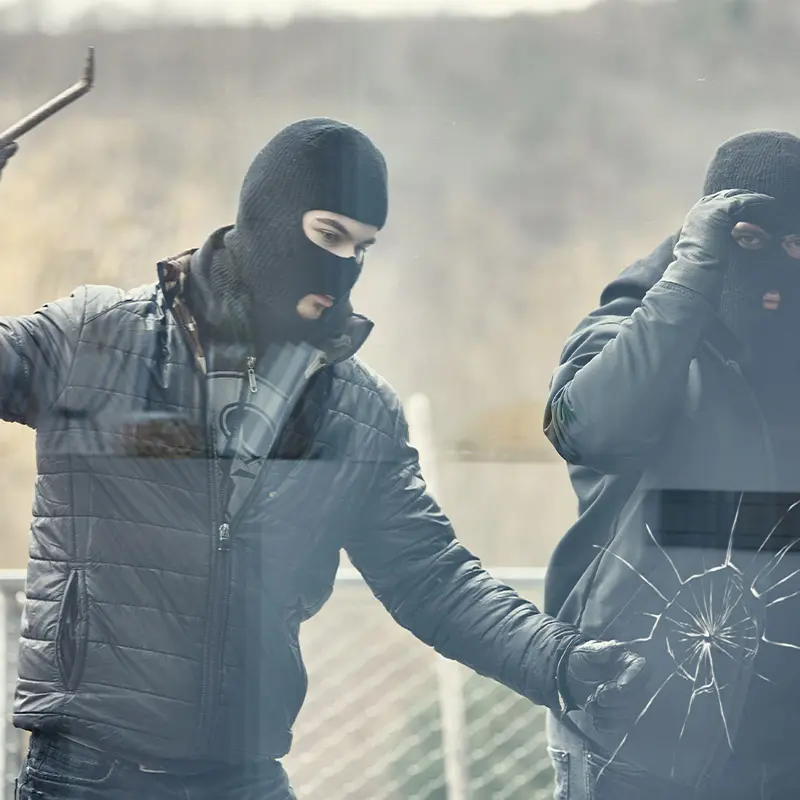
Security film is a thick polyester layer bonded to the interior surface of existing glass with a structural adhesive. When the glass breaks, the film keeps working.
Broken fragments stay bonded to the film instead of scattering across the floor or falling out of the frame.
Fewer loose shards means fewer injuries during a break-in, storm impact, or accident.
An intruder needs more strikes and more time to create an opening large enough to climb through.
A burglar who cannot get in quickly is more likely to move on to an easier target.
Up to 99% of UVA and UVB rays, helping protect occupants, furniture, flooring, and artwork from UV exposure and fading.
When engineered and attached correctly, film can help retain glass during severe weather or pressure events.
See Security Film in Action
See real-world demonstrations that help show how security film behaves when glass is put under stress.
Know the Difference
They are not interchangeable. Confusing them is exactly how misleading security claims spread.
Provide visibility and normal weather protection.
Resistance to forced entry or gunfire.
Hold broken glass together and reduce flying shards.
Keeping the pane in the frame under repeated force.
Retain glass in the frame, delay entry, and support blast mitigation.
That an intruder can never get in.
Improve glass retention and impact resistance.
Ballistic protection without a tested rating.
Resist a specific tested threat under UL 752 or a comparable standard.
Stopping every weapon at every threat level.
UL 752 and ASTM standards test complete, engineered assemblies against defined threats. A retrofit film system and a tested ballistic glazing assembly are different products built for different risks.
The Weak-Link Problem
Film thickness gets most of the attention in security advertising, but thickness is only one part of the opening.
Security film holds broken glass together. A separate attachment system holds that filmed glass to the frame, and skipping it is one of the most common shortcuts in the industry.
Glass and film can stay bonded to each other while still separating from the frame as one large piece. A serious security evaluation looks at the entire opening, not just the glass in front of it.
A Different Product Entirely
What people call “bulletproof glass” is more accurately described as bullet-resistant glazing. It is an engineered assembly built from combinations of glass, polycarbonate, acrylic, and specialized interlayers.
The complete assembly is tested and rated against a specific threat under UL 752 or a comparable ASTM standard. A system rated to stop a handgun round is not automatically rated for a rifle round, and the surrounding frame has to be engineered to match the glazing it holds.
Match the System to the Risk
Most homes, offices, schools, and storefronts need what security film provides. Facilities facing a defined ballistic threat need an entirely different engineered system.
Before You Buy
A professional company should answer every one of these without reaching for words like “unbreakable” or “bulletproof.”
01What exact film will be installed, and at what thickness?
02Will the film be attached to the frame, and with what system?
03Has the complete assembly—film and frame together—been independently tested?
04What glass type and frame were used during that test?
05Is the claim about glass retention, forced-entry delay, or ballistic resistance?
06What does the written warranty actually cover, and what does it exclude?
The Sun Stoppers Approach
We do not sell security through fear, and we do not promise more than a product can deliver. Every assessment starts with the existing glass, the condition of the frame, and what you are trying to protect against in the first place.
From there, we explain what the recommended film and attachment system are built to do, how the installation works, and where the limits of that system begin. Properly selected and correctly installed, security film is one of the most effective upgrades available for existing glass.
Commercial & Office Security Film
Every glass opening is different. Tell us about your windows and doors, and we will walk you through exactly what a security film system can and cannot do for your property.