
 Visit Us Today

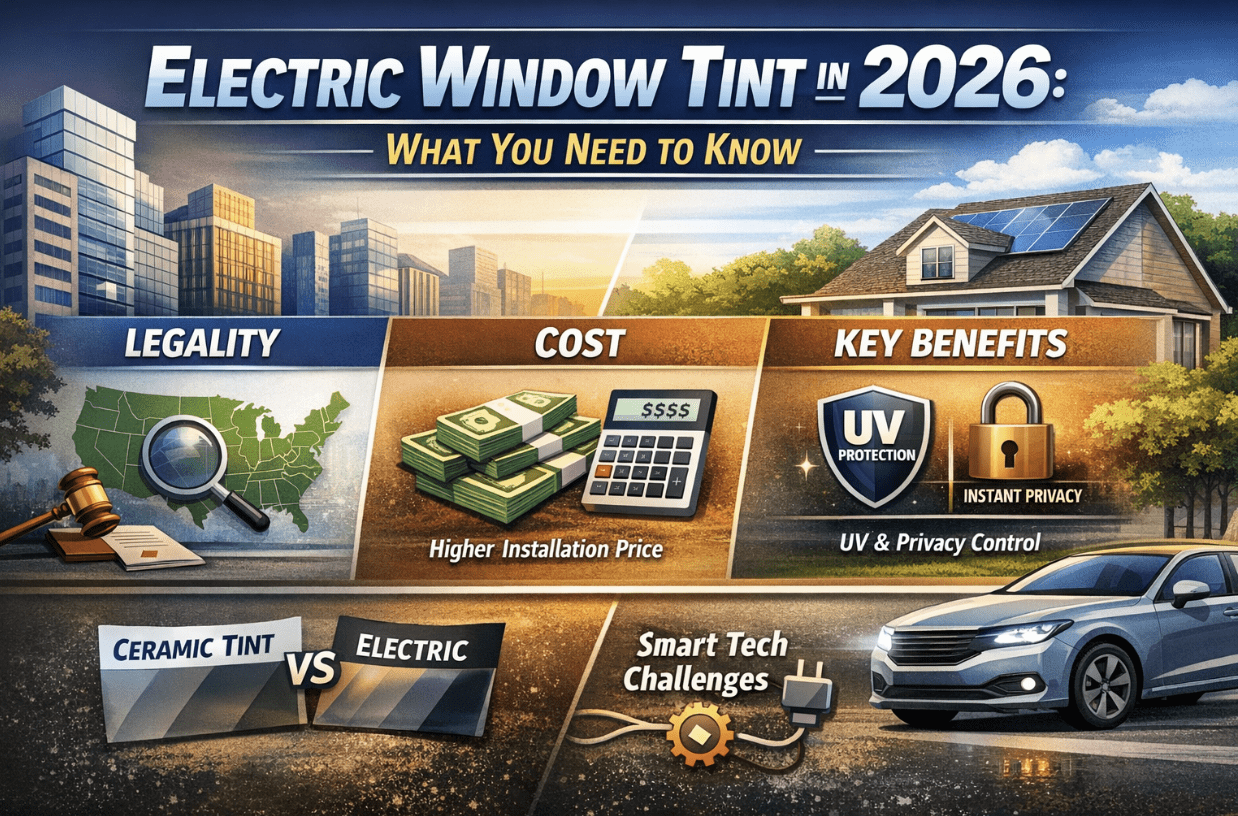
Electric window tint technology sounds futuristic. Tap a button. Instantly switch from clear to private. No permanent dark film on the glass.
What most brochures don’t explain is the real-world cost and complexity. For vehicles, smart or PDLC tint is typically priced per vehicle, not per window. Most automotive installations fall somewhere between $500 and $2,500, depending on vehicle size, window count, and how much electrical integration is required. Why is the price tag so high? Because, it’s not just a film. It involves wiring, control modules, and integration into your vehicle’s electrical system. And like any electronic system, performance can vary in extreme temperatures.
If you’ve searched for electrically tinted windows, chances are you are trying to solve a practical problem. Too much heat. Glare that causes eye strain. A desire for privacy without sacrificing visibility. What many car owners are surprised to learn is that modern ceramic window films already solve these problems, often more consistently and at a fraction of the cost, without relying on electronics.
This guide explains what electric tint window film really is in 2026, where it’s actually being used, how it works, what it costs, and why many people researching electric tint ultimately choose high-performance ceramic window film instead.
At Sun Stoppers, we work across automotive, residential, and commercial applications, helping clients understand the difference between emerging technology and proven performance. With over 150,000 installations completed over 36+ years, we’ve seen how and where ceramic window tints have simply performed better.
Interest in smart and electric window tint has grown quickly. We understand the appeal of new technology. But we also know how frustrating it can be to sort through conflicting information. Our focus is simple: Help you choose what actually works for your vehicle, your driving conditions, and your budget. Whether that means exploring electric auto window tint or understanding why ceramic film outperforms it in most real-world situations, we’ll explain it clearly. Call 704-893-0097 to speak with a window tint specialist.
“Sun Stoppers is the largest XPEL dealer in the world, with over 150,000 window tint installations completed since 1988. With a Guinness World Record for tint installations in a single day and a 4.8-star average across 1,900+ reviews, our nationwide team specializes in premium ceramic films and automotive protection services.”
What Is Electric Window Tint and Why Is It Gaining Attention in 2026?
Electric auto window tint, often referred to as smart window tint, is a technology that allows glass to change its appearance using electricity.
Instead of staying permanently tinted, the glass can switch between clear and opaque states. This change happens instantly and is controlled by a switch, remote, or smart system.
Unlike traditional window film, electrically tinted windows do not rely on darkness to block views. They control visibility, not shade. When activated, the glass turns cloudy or frosted, limiting what can be seen through it. When powered, it returns to a clear state.
This makes electric window tint fundamentally different from ceramic or dyed window film. It is not a surface-level upgrade. It is an electronically controlled system designed for adaptable spaces.
Why Electric Window Tint Is a Popular Choice in 2026
Interest in automotive electric window tint has grown sharply in 2026 because it aligns with how people now design and use spaces. Homes, vehicles, and offices are no longer static. They are expected to adapt in real time. Electric window tint fits that expectation.
It offers on-demand privacy without permanent visual changes, integrating naturally with smart environments. And it appeals to buyers who value control over fixed solutions.
What’s interesting is how people are engaging with it.
Interest in smart window tint has noticeably increased over the past few years. Based on observed search behavior and industry conversations, more consumers are researching retrofit-friendly smart tint solutions rather than full smart glass replacements. This suggests curiosity about electric tint for windows in 2026 is growing, especially among vehicle owners and homeowners looking for adaptable privacy without replacing entire glass panels.
That curiosity is driven by a few clear factors.
- Instant privacy on demand: Glass can turn opaque in seconds without blinds, curtains, or shades.
- Clean, modern aesthetics: It preserves open, glass-heavy designs without sacrificing privacy.
- Smart building and smart vehicle integration: Many systems connect with automation platforms, switches, or sensors.
- Energy and comfort benefits: By diffusing light and reducing direct solar exposure, it can help manage interior heat and glare.
- Multi-purpose functionality: In commercial settings, electric tint can double as a projection surface or privacy divider.
This combination of control, design, and technology explains why electric window tint is frequently discussed alongside other smart upgrades in 2026.
However, popularity does not always mean practicality.
To understand where electric car window tint truly performs well, and where expectations often exceed reality, it helps to look closely at how the technology actually works.
How does Electric Auto Window Tint Work?
Electric window tint works by using electric current to control how light passes through glass. Instead of darkening the glass, window electric tint changes visibility on demand.
When power is applied, the glass reacts instantly. When power is removed, it shifts back just as fast. That switch is what separates electric tint window film from other tint options.
Understand a Real-World Perspective from Sun Stoppers
One of the most relevant insights comes from Mike Burke, who regularly demonstrates how different window tint technologies affect heat, clarity, and comfort in real vehicles.
Sun Stoppers — Electric vs Ceramic Window Tint Real-World Comparison
The Core Technology Behind Electric Window Tint
Most automotive electric window tint systems use PDLC, which stands for Polymer Dispersed Liquid Crystal. Inside the film are microscopic liquid crystals suspended in a clear layer.
When electricity is applied:
- The crystals align
- Light passes through
- The glass appears clear
When electricity is turned off:
- The crystals scatter
- Light diffuses
- The glass turns opaque or frosted
However, it’s important to note that some PDLC variants are reverse-wired, meaning they default to clear when unpowered and turn opaque when electricity is applied. The operational behavior depends on the manufacturer and system design. Always confirm the default state before purchasing, especially for automotive applications where visibility and safety are critical.
What Electric Window Tint Controls (and What It Doesn’t)
Electric auto window tint controls visibility, meaning it decides whether people can see through the glass or not. It does not primarily control darkness the way ceramic or dyed films do.
That distinction matters. Opaque does not mean dark. Frosted does not mean cool. Some heat reduction happens, but privacy is the main function.
Understanding the Power, Wiring, and Control Systems
Window electric tint requires a constant power source. Most systems run on low voltage and are wired into:
- Wall frames
- Window frames
- Door panels
- Vehicle electrical systems
Controls can include:
- Wall switches
- Remote controls
- Smart home systems
- Automation platforms
If power is lost, most systems default to clear. This is intentional and important for safety.
Other Smart Tint Technologies you might hear about
You may also see references to electrochromic glass. This type of smart glass darkens gradually when voltage is applied. It’s commonly found in factory-installed automotive glass or large architectural projects.
- It looks seamless.
- It reacts slowly.
- And it’s rarely available as a retrofit.
For most existing windows, PDLC-based electric tint is the option people are actually considering.
Why this Matters before Choosing Window Electric Tint
Electric auto glass tint is not just a film upgrade. It’s a system. That system brings flexibility, but also complexity. Understanding how it works explains:
- Why installation costs are higher
- Why repairs are more involved
- Why it fits some environments better than others
And that leads to the next logical question: Where does it make sense to use electric tint for windows?
Where Electric Window Tint Is Used (and Where It Isn’t)
Window electric tint is not a novelty anymore, but it’s also not a universal solution.
Its value depends entirely on how and where it’s used. When it solves the right problem, it makes sense. When it’s forced into the wrong role, it quickly becomes expensive frustration.
Common Applications of Electric Auto Window Tint
Electric tint works best in environments where privacy control matters more than heat rejection or darkness. That’s why it’s commonly used in:
- Commercial offices and conference rooms: Instant privacy without blinds, curtains, or permanent frosting.
- Medical and healthcare settings: Exam rooms, treatment areas, and patient privacy zones.
- High-end residential spaces: Bathrooms, entryways, interior glass walls, and partitions.
- Luxury architectural projects: Homes and buildings that are already designed around smart systems and automation.
In these spaces, switching from clear to opaque on demand solves a real, daily problem.
How high-end Car Owners use Electric Auto Window Tint
Yes, window electric tint is used by high-end vehicle owners, but in very specific ways.
It’s most common in:
- Chauffeur-driven luxury vehicles
- Executive and VIP transport fleets
- Ultra-luxury or concept builds
- Vehicles already built around advanced electronics
In these cases, electric tint is typically installed on:
- Rear passenger windows
- Privacy partitions
- Interior glass panels
Not the entire vehicle. For these owners, privacy is the priority, not maximum heat rejection or dark aesthetics.
Where Electric Tint Window Film is Often Misunderstood
Electric auto window tint is frequently marketed as a replacement for traditional automotive window film. This is where expectations fall apart.
In vehicles, electric auto window tint:
- Controls visibility, not true darkness
- Does not outperform ceramic film for heat rejection
- Adds wiring, controls, and electrical dependencies
- Increases long-term repair and replacement costs
That’s why even luxury and electric vehicle owners rarely rely on electric tint alone. Instead, they combine technologies.
Where It Usually Isn’t the Right Choice
Electrically tinted windows are often a poor fit for:
- Windshields, where visibility and safety are critical
- High-heat climates, where privacy does not equal cooling
- Daily drivers, where reliability matters more than novelty
- Retrofits without easy electrical access, where installation becomes invasive
In these scenarios, performance-focused solutions like modern ceramic window film consistently deliver better long-term results.
Why this Distinction Matters
Electrically tinted windows controls privacy. Ceramic window film controls heat, glare, and UV exposure. They solve different problems.
Understanding where each technology actually fits helps buyers avoid overspending and disappointment. It also explains why many drivers who start by researching electrically tinted windows ultimately choose ceramic solutions once real-world performance is compared.
And that naturally leads to the next question most people ask: Are electrically tinted windows better than ceramic tint for everyday use? That’s what we’ll break down next.
Thinking About Electric Window Tint for Your Vehicle or Space?
At Sun Stoppers, we help you compare real performance, long-term reliability, and total cost before you commit. Whether you’re exploring smart tint for privacy or ceramic film for heat and UV protection, we’ll walk you through the options clearly.
Cons of Automotive Electric Window Tint (The Honest Trade-Offs)
The window electric tint sounds impressive on paper. And in the right environment, it genuinely is. But it is not a universal upgrade, and that’s where many buyers get caught off guard.
Let’s break this down clearly.
1. Cost is Significantly Higher
This is the biggest surprise for most buyers. Electric tint is not a film-only upgrade. It’s a system.
Costs often include:
- Specialized film or glass
- Electrical wiring
- Control modules
- Installation labor
For vehicles or large spaces, pricing can be several times higher than premium ceramic tint.
2. Heat Rejection is Not its Primary Strength
This is an important distinction. Automotive electric window tint is designed for privacy, not maximum heat rejection.
While it does reduce some solar heat, it does not consistently outperform high-end ceramic films when it comes to:
- Infrared heat rejection
- Cabin cooling efficiency
- Long-term thermal comfort
For drivers focused on staying cool, this matters.
3. Requires Power and Wiring
Electric tint must stay connected to a power source. That means:
- Wiring through doors and frames
- Control systems that must remain functional
- More points of failure over time
Also, if power is lost, most systems default to clear for safety reasons.
4. Maintenance and Repairs Are More Complex
Traditional window film is simple. Electric tint is not. If something fails, repairs may involve:
- Electrical diagnostics
- Component replacement
- Software or control issues
It’s not a peel-and-replace situation.
5. Legal Limitations Still Apply (Especially for Cars)
Even though it’s switchable, electric tint for windows must still comply with local VLT laws when in its darkest usable state. This limits where and how it can be used on vehicles.
Electric Window Tint vs Ceramic Window Tint (What Performs Better in 2026)
By the time most people reach this point, they’re no longer asking what is electric tint for windows? They’re asking something more practical.
Which one actually works better for me?
Electric and ceramic window tints are often compared, but they are built for different jobs. Understanding that difference saves money, time, and regret.
1. What Each Technology is Designed To Do
Electric window tint (smart tint / PDLC)
Electric tint is built around switchable privacy. Its core job is to change visibility on demand. It excels in:
- Privacy control
- Interior partitions
- Architectural and commercial environments
- Select luxury and concept vehicles
Ceramic window tint
Ceramic tint is built around thermal and UV performance. Its job is to improve comfort every time the vehicle or building is in use. It excels in:
- Heat rejection
- UV protection
- Glare reduction
- Daily driving and long-term ownership
Different purposes. Different outcome.
2. Real-World Performance Differences (Not Marketing Claims)
This is where expectations often shift. Electric tint can look impressive in demonstrations. Ceramic tint proves itself over years of use.
| Feature | Electric Window Tint | Ceramic Window Tint |
|---|---|---|
| Privacy | Instant privacy at the push of a button | Privacy depends on film shade, not switchable |
| Heat rejection | Secondary benefit, not its main function | Designed specifically for heat control |
| Clarity | Can appear frosted or milky when off | Always optically clear |
| Reliability | Dependent on power, wiring, and controllers | Passive system, no electronics involved |
3. Cost, Ownership, and Long-Term Reality
This is where many buyers change direction. Electric tint for windows is not just a film upgrade. It’s a system.
That system includes:
- Electrical integration
- Control modules
- Ongoing dependency on power
Ceramic tint is simpler by design:
- One-time installation
- No electrical dependency
- Lifetime warranties available
That simplicity is why ceramic remains the dominant choice for vehicles in 2026.
4. Why Most Luxury Vehicle Owners Still Choose Ceramic
Despite growing interest in smart tint technology, adoption tells a clear story. Film-based solutions remain the most installed option in automotive applications because they:
- Deliver consistent heat rejection
- Maintain full visibility
- Perform the same in all climates
- Require no system maintenance
At Sun Stoppers, we see this decision play out daily across luxury and performance vehicles. Clients often explore electric tint first. Once costs, installation complexity, and real-world performance are explained, ceramic is usually the better fit for how vehicles are actually used.
5. Electric Window Tint vs Ceramic Tint: A Quick Comparison
| Feature | Electric Window Tint | Ceramic Window Tint |
|---|---|---|
| Primary purpose | Switchable privacy | Heat and UV protection |
| Visibility control | On / off or adjustable | Fixed, always clear |
| Heat rejection | Moderate | High — up to 98% IR |
| UV protection | Strong | Up to 99% UV |
| Power required | Yes | No |
| Installation complexity | High | Moderate |
| Maintenance | Possible system repairs | Minimal |
| Best for | Offices, partitions, specialty use | Cars, daily driving, homes |
| Cost over time | Higher | Lower |
Is Electric Window Tint Worth It in 2026? A Clear Decision Guide
Electric tint window film is impressive technology. But in 2026, the right choice still comes down to how you actually use the space, not how advanced the feature sounds.
Here’s how to decide without second-guessing later.
Electric Window Tint Is Worth It If You:
- Need instant privacy on demand, not permanent shading
- Are designing or renovating a luxury home, office, or medical space
- Want a clean, modern aesthetic with no blinds or curtains
- Are comfortable with higher upfront cost and system-based maintenance
- Value smart integration over maximum heat rejection
Electric Window Tint Is Probably Not the Right Fit If You:
- Want the best heat rejection for driving comfort or energy savings
- Are focused on UV protection and interior longevity
- Prefer a simple, maintenance-free solution
- Are working within a practical budget
- Expect tint to perform consistently across extreme temperatures
Why Most Buyers End Up Choosing Ceramic Film
High-performance ceramic tint has matured, delivering measurable performance without electrical complexity.
It offers:
- Strong infrared heat rejection
- Excellent UV protection
- Long-term reliability
- Legal compliance when installed correctly
- Lower total cost of ownership
That balance is hard to ignore, especially for vehicles and daily-use spaces.
Talk to a Specialist Before You Commit
At Sun Stoppers, we work with both technologies and see how they perform in real-world conditions every day. We don’t push trends. We explain trade-offs.
If you’re considering electric window tint for your car, home, or commercial space and want a clear, honest recommendation based on:
- Your environment
- Your usage
- Your budget
Our specialists are available to walk you through your options and explain what will work best long term. Call us on 704-893-0097 or request a free quote from your nearest Sun Stoppers location.
Is Electric Tint Legal in 2026?
The short answer is yes, sometimes. The real answer depends on where it’s used and local regulations.
Automotive Window Tint Laws (Cars and Trucks)
For vehicles, electric auto window tint is regulated the same way as traditional window tint. What matters most is visible light transmission (VLT). VLT is the percentage of visible light allowed to pass through the glass. Lower numbers mean darker windows.
In the U.S., tint laws are set at the state level. Each state defines legal limits by window type with windshield regulations being typically much stricter than side window rules.
Most states:
- Prohibit full windshield tinting below factory transparency
- Only allow a non-reflective strip (commonly called an AS-1 line) across the top
- Restrict aftermarket film on windshields beyond medical exemptions
An Overview on U.S. Tint Laws:
- California: Front side windows must allow 70% VLT or more. Windshield tint is limited to a top strip only.
- Florida: Front side windows require at least 28% VLT. Windshield tint is restricted to a top band.
- Texas: Front side windows must allow 25% VLT or more. Windshield tint is limited to an approved strip above the AS-1 line.
Because there’s no single nationwide rule, checking your specific state’s tint laws is essential before installing any electric or smart tint.
Important to know: Even though the electric tint is switchable, it is tested in its darkest usable state. The ability to turn it clear does not override VLT laws. Windshield compliance is especially strict.
Home and Commercial Window Tint Laws
For homes and commercial buildings, regulations are generally more flexible, but they still exist. Residential and commercial installations don’t usually follow the same VLT restrictions as vehicles. Instead, legality is influenced by:
- Local building and energy codes
- Fire and safety regulations
- Historic district rules or HOA guidelines
In many areas, interior electric glass tint used for privacy or light control is fully acceptable. Exterior-facing glass changes may require approval in regulated neighborhoods or shared buildings.
If you’re modifying glass in an HOA, medical facility, or commercial property, it’s always smart to confirm requirements with local authorities first.
Key Things to Know About Legality
- Automotive laws vary by location: Rules differ not just by state, but also by window type. Windshields, front sides, rear sides, and rear windows often have different limits.
- VLT still applies to electric tint: Electric or smart tint is measured by visibility, not by technology. If the darkest setting falls below legal limits, it may be considered illegal on a vehicle.
- Penalties can add up: Non-compliant tint can result in fines, failed inspections, or mandatory removal, depending on local enforcement.
- Factory tint is treated differently: Many vehicles come with factory privacy glass, typically in the 15–26% VLT range. These are usually legal because they meet manufacturer and safety standards.
Quick Tip Before You Install
Electrically tinted windows may feel futuristic, but tint laws still focus on visibility and safety, not innovation. Before installing:
- Check your local automotive tint laws
- Ask your installer about legal VLT limits
- Confirm building or HOA rules for homes and offices
Doing this upfront avoids fines, rework, and unnecessary stress later.
Find Out What Window Tint Laws Allow in Your State
If you’re considering electric window tint for a car, home, or commercial space and want to make sure it’s legal where you live, talk to a specialist first.
FAQs About Electric Window Tint
1. Is electric window tint the same as smart glass?
Not always. Electrically tinted windows usually refers to PDLC smart film, which is applied to existing glass. Smart glass can also include electrochromic glass, which is factory-manufactured and changes shade gradually. PDLC is more common for retrofits; electrochromic glass is usually OEM or architectural.
2. Does an electric window tint block heat like a ceramic tint?
No, not in the same way. Electric window tint is designed for privacy, not maximum heat rejection. While it can block UV and reduce some infrared heat, high-performance ceramic window tint still outperforms electric tint for keeping interiors cool.
3. Can electric window tint be installed on cars, homes, and offices?
Yes, electric tint for windows is used in luxury vehicles and concept cars, conference rooms and office partitions, medical facilities and privacy spaces, and high-end residential interiors. However, usage rules and practicality vary by environment.
4. Is electric window tint legal on cars in 2026?
It depends on your location. Automotive tint laws are based on visible light transmission (VLT). Even if the tint is electric, it must remain legal in its darkest or opaque state. Some regions allow it; others restrict or prohibit it on front windows or windshields. Always check state or country-specific tint laws before installing.
5. What happens if an electric tint window film loses power?
Most systems are designed to fail safely, meaning they default to clear if power is lost. This is critical for driving safety and building egress requirements. However, when something fails, repairs can be costly and lengthy, due to the electrical complexity of the system.
Sun Stoppers — Largest XPEL Dealer in the World
150,000+ installations since 1988. Guinness World Record holder. 4.8 stars across 1,900+ reviews. Premium ceramic films and automotive protection nationwide.